
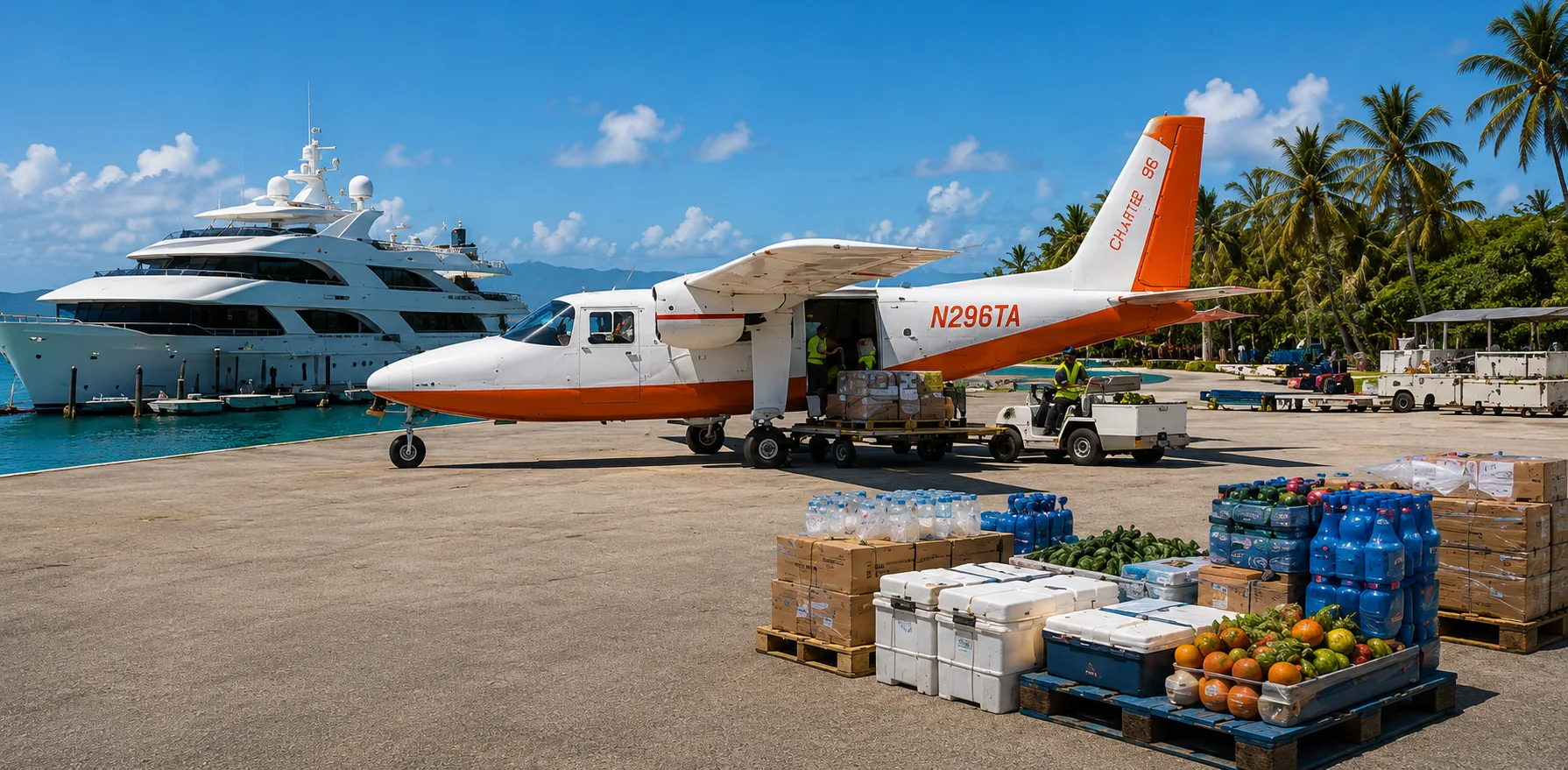
Nassau Lynden Pindling
The main Bahamian ramp, with clearance on site, storage nearby and direct legs to the Florida coast.
Drive time from the port
Flight time to South Florida
Planning for islands, cays, marinas and limited access destinations, including the last leg by boat or cart.
Receiving, consolidation, packing, scheduling and delivery. We take care of every step, so you do not have to.
Reliable air and sea access across Florida, the Keys and the Bahamian islands, on your timeline.
Aircraft, load plan, handling and documentation matched to the cargo and the destination, not the other way around.
A named planner stays with the mission, so supplier, broker, crew and receiver share the same information.
How It Works
Tell us what needs to move, where it is going and when it is needed, with weights, dimensions and any handling or permit requirements.
We review the cargo, the timing, the packaging and the access at the destination, then confirm the aircraft, the last leg and the documentation.
Loading, clearance, handling and final delivery to the property, the dock or the site, with one contact on the mission until it is signed for.
Departure Points
The main Bahamian ramp, with clearance on site, storage nearby and direct legs to the Florida coast.
Drive time from the port
Flight time to South Florida
The Out Islands ramp for outbound seafood, samples and equipment returning for service.
Drive time from Emerald Bay
Flight time to Miami
Northern Bahamas access, with clearance before the crossing and boat transfer from the cays.
Drive time from Elbow Cay
Flight time to West Palm Beach
The gateway for Harbour Island, with the freight tender or water taxi arranged at the dock.
Drive time from Dunmore Town
Flight time to Fort Lauderdale
A staging point as well as a destination, with storage and a short crossing to the Florida coast.
Drive time from the industrial park
Flight time to West Palm Beach
Supply Missions
The five supply missions our logistics desk plans most often from the Bahamas, each documented, flown and delivered end to end.
Miami is the largest receiving point for island freight and the easiest place to connect onward. Missions from the Bahamas carry seafood and produce for market, equipment returning for repair, samples, reusable packaging and personal effects, cleared at a private ramp rather than a congested freight hall. Our team prepares the entry, coordinates with your broker and arranges trucking to the warehouse or a connecting flight north the same day. Because these legs often return from a supply run, capacity is frequently available at short notice.
Bahamas to Miami→Fort Lauderdale is the natural return point for anything connected to the marine industry, which is most of what leaves the islands. Missions from the Bahamas bring marine hardware for service, tenders' equipment, yacht stores being repatriated, samples and crew effects into a private ramp beside the yards and the chandlers. Clearance is handled on site, our team works the entry with your broker and delivery to the yard, the warehouse or the marina is arranged at the far end. Outbound capacity on the same aircraft is usually available.
Bahamas to Fort Lauderdale→West Palm Beach is the shortest mainland crossing from the upper Bahamas, which makes it the natural return point for outbound island freight. Missions from the Bahamas carry seafood, samples, marine parts and equipment going back for service into a private ramp where clearance happens without a wait in a freight hall. Our team prepares the entry, works with your broker and arranges onward trucking the same day. The lane is also used for outbound provisioning, so capacity in both directions is usually available.
Bahamas to West Palm Beach→The Keys sit between the mainland and the islands, which makes them both a destination and a staging point. Missions from the Bahamas deliver into Key West or Marathon, close to the marina, the restaurant or the site that needs the shipment, with onward movement along the chain by road or boat. We measure and palletise to the aircraft, confirm ramp access and handling at both ends and arrange the final delivery. Recurring supply for clubs, restaurants and property managers can be scheduled weekly.
Bahamas to the Keys→Crossing the peninsula by road costs most of a working day and the Gulf coast has its own marine, medical and construction supply needs. Missions from the Bahamas reach Naples, Marco Island and Fort Myers directly, carrying marine parts, project materials, medical shipments and perishable orders. Loads are documented and measured before departure, ramp access is confirmed with the operator and delivery to the marina, the site or the warehouse is arranged at the far end. Return legs can carry outbound freight rather than flying empty.
Bahamas to Naples→Destinations Reached
Where most Bahamian supply touches land. Hotel and restaurant runs, retail stock and parts, with entries prepared before departure and delivery arranged from the ramp to the property. Nassau island logistics
Small strips, no road network and a boat on the end of every delivery. Provisions, materials and household goods on a weekly schedule rather than a series of emergencies. Exuma island logistics
Project cargo, marine hardware and restaurant supply for settlements spread along a shallow sea, sequenced to the build programme and delivered by tender to the cays. Abaco island logistics
Every shipment ends with a boat and a cart, so packaging and labelling are planned for three handlings. Hotel, restaurant and villa supply runs weekly. Harbour Island island logistics
Close enough for same day provisioning, which changes how a marina or a resort orders. Produce, seafood, beverages and marina consumables with the cold chain intact. Bimini island logistics
Real infrastructure and a short crossing, so it works as a destination and as a staging point for smaller islands, with storage and bonded holding available. Grand Bahama island logistics
One road in and out. Urgent parts, restaurant supply, event and film equipment, with onward movement along the chain by road or boat. Florida Keys island logistics
Limited infrastructure, restricted access and often no strip at all. We plan the last leg with a seaplane, a helicopter or a boat and confirm permission before the mission is booked. Private island logistics
Capabilities
Most island shipments are damaged or delayed by how they were packed and described, not by how they were flown. We review the load before it moves: packaging that survives an aircraft, a dock and a cart, labelling that matches the manifest, palletising measured to the aircraft rather than the truck and descriptions a customs officer accepts without a query. Receiving, storage, consolidation and repacking can be handled at our staging points on request, so several suppliers become one clean shipment with one set of documents.
Prepare a shipment→Provisioning is unforgiving because the vessel moves and the window is short. We fly food, beverages, spares, marine hardware, tender equipment and crew personal effects to the island nearest the anchorage, then coordinate the tender or the dock transfer with the captain directly. Cold chain items are staged in temperature control and handed over without a break. Stores entries are prepared in advance with the correct treatment for yacht supply and the captain, the purser and the shore agent work from the same information throughout the mission.
Provision a yacht→Hospitality on an island runs on a reliable weekly rhythm rather than heroic single deliveries. We build scheduled supply runs for resorts, restaurants, private islands and villa portfolios: produce and seafood, beverages, linens, amenities, cleaning consumables, small equipment and retail stock. Orders from several suppliers are consolidated, documented once and flown together. Mission review, destination handling and delivery to the property are confirmed before each run and the schedule is agreed in advance so kitchens and housekeeping can order against it.
Resort and island supply→Island construction stops when a part does not arrive and a stopped site costs more than a flight. We move tools, fixings, cabinetry, appliances, generators, marine hardware, tiles and finishing materials into strips that larger freighters cannot use, with dimensions, weight and handling instructions confirmed before booking. Deliveries are sequenced to the build programme rather than dumped in one load and we coordinate directly with the contractor or the project manager. Longer projects move onto a weekly schedule with the same crew and agents.
Construction support→Food fails slowly and invisibly, so these missions are planned backwards from the receiving end. Shipments are staged in temperature control, ramp time is kept short, refrigerated transport waits at the far end and product condition is confirmed on handover. Packaging and labelling requirements are agreed with you in advance and cold chain documentation forms part of the customs entry rather than an afterthought. Where a route or a season makes a chilled shipment unsafe, we say so and propose a different day or a different product mix.
Perishables and provisions→Forwarders and shippers use us as the island leg of their own service, not as a competitor. We work to your documentation, your broker and your customer's timeline and we do not approach your client. Contents, weights, dimensions, packaging and hazardous declarations are reviewed before the aircraft is confirmed and delivery updates come back to you rather than to your customer. For regular lanes we agree capacity and process in advance, so a booking becomes a short message rather than a negotiation.
Freight partner support→Island logistics is the work that happens either side of the flight. From the Bahamas we receive, consolidate and document a shipment, choose the aircraft that fits the strip and the load and plan the last leg that a boat or a cart will actually carry out. One planner stays with the mission, so the supplier, the broker, the crew and the person receiving it work from the same information. The result is a delivery date you can order against rather than an estimate that moves.
Missions from Bahamas→Hospitality runs on rhythm. A resort or a private island that receives a reliable weekly run can order properly, hold less stock and stop paying for emergency freight. We consolidate orders from several suppliers into one documented shipment, fly it on a fixed day and deliver to the property rather than the airport. Cold chain items travel with the chain intact and the schedule is agreed in advance with your kitchen, housekeeping and maintenance teams so each has a slot in the load.
Resort and island supply→The harder a destination is, the more of the work happens before the aircraft moves. Remote cays and private islands can have short strips, no strip at all, restricted access or no equipment to unload with. We survey the destination, confirm permission and handling, choose between a small plane, a seaplane, a helicopter or a boat for the final leg and package the load so it can be moved by hand if that is what waits at the other end. Nothing is assumed.
Remote deliveries→Paperwork stops more island shipments than weather does. Commercial goods, yacht stores, construction materials, personal effects and food all attract different treatment and a description that satisfies one officer can be queried by another. Our desk prepares the manifest and the entry, works with your broker, applies the correct treatment for the goods and the destination and confirms the receiving contact before departure. Where a shipment needs a permit or an inspection, we tell you at the enquiry stage rather than on the day.
Documentation guidance→Island supply is a chain and the flight is only one link in it. A run leaving Miami, Fort Lauderdale or West Palm Beach for Nassau, Staniel Cay or Harbour Island succeeds or fails on what happened before it: how the load was received, consolidated, packed, labelled and documented. That work is what island logistics means here and it is why a mission has a named planner rather than a tracking number.
The destination sets the aircraft and the last leg. Small strips in Exuma, North Eleuthera and Abaco are flown by small plane with a cargo pod for volume; a dock or a beach calls for a seaplane; a yacht deck or an inland site can need a helicopter; and urgent single shipments go as a dedicated cargo charter. Where people and supply move together we plan a combination mission instead of two bookings.
Most delays are documentary. Commercial goods, yacht stores, construction materials, perishables and personal effects each attract different treatment, so our desk prepares the manifest and the entry, applies the correct treatment for the destination and works with your broker, following the documentation guidance and restricted goods rules. Permits and inspections are flagged at the enquiry stage. Weather and access are handled the same way, under the weather and delays policy.
Delivery beyond the airport is part of the mission: ground transport, dock pickup, tender transfers, provisioning, cold storage and staging in Florida. Resorts, restaurants, villa managers and contractors move recurring supply onto scheduled weekly runs and freight partners agree capacity and process in advance. To begin, send what is moving, where it is going and when it is needed to the logistics desk or plan a mission.
Questions
Receiving and storage at our staging points, consolidation of orders from several suppliers, packaging and labelling reviewed for the way the load will be handled, palletising measured to the aircraft, the manifest and customs entry, ramp handling at both ends and final delivery to the property, the dock or the site. Where a shipment needs a permit, an inspection or cold storage, that is arranged as part of the mission. One planner stays with it from enquiry to signature.
Often yes, but the last leg decides the plan. Where there is no strip we combine an aircraft into the nearest field with a boat, a seaplane or a helicopter for the final movement and we package the load so it can be handled without equipment if none is available. Access permission, tide, dock condition and who receives the shipment are confirmed before the mission is booked. Where a delivery cannot be made safely we say so and propose an alternative.
We agree a fixed day and a cut off time for orders, receive shipments from your suppliers at our staging point, consolidate and document them as one load and fly the run on the same schedule each week with the same handling agents. Your kitchen, housekeeping and maintenance teams each hold a slot in the load. Capacity is reviewed against the season and additional urgent missions can be added between scheduled runs when something cannot wait.
Dangerous goods, fuels, certain batteries, some chemicals, aerosols and specific building products are restricted or prohibited depending on the aircraft, the operator and the destination. Live animals, firearms and controlled substances have their own rules. Some goods cannot share a cabin with passengers on a combination mission. Tell us what is moving at the enquiry stage and we will confirm what can travel, under what conditions and what documentation is required.
Our logistics desk prepares the manifest and the entry and works with your broker, or ours where you do not have one. Treatment differs by destination and by the nature of the goods, particularly for commercial shipments, yacht stores and construction materials. Clearance usually happens at a private ramp rather than a congested freight terminal and the receiving contact is confirmed by name before departure so nothing waits on the apron for a signature.
Yes, pets travel in the cabin with you. The one thing we ask is that you tell us at the enquiry, with the type of animal and its weight, so the seating and the load plan are right from the start.
Logistics Desk
Send us what is moving, where it is going and when it is needed. A logistics planner replies with the supply solution, the documentation required and a delivery plan.
Explore
